Monday, November 10, 2014
New Light
Introducing our newest family member, my beautiful new baby granddaughter, born November 8th, 2014, weighing 6 lbs,14 ozs.
At this darkening time of the year, we celebrate her birth as a bringer of light, and much joy. I feel awash with a passion of tenderness.
It's a subtle change like the scent of new snow, but I know the world has changed since the birth of this new little girl. I wonder what textures baby E will make of the mosaic around her. Right now she is the heart of life, around whose centre everything else is peripheral. The source of that love is divine, and gathers each of us into its blessedness.
Tuesday, October 21, 2014
By the Light of the Moon
(Walking in Moonlight, by Nicole Wong)
A very real little boy went for a walk with his very real Nana one silvery spring evening. A huge, full round moon filled the night sky with light as his warm little hand pressed hers.
“When I am a hundred years old, I will catch up with the moon?” the little boy said.
“What will you say to her?” said his
Nana.
“Moon, do you ever
get tired of shining?” replied the boy.“What do you think she will answer?” asked his Nana.
“No, because I will shine forever and ever.”
“And then”, said the little boy, his arm gesturing upward, “the moon will give me a tiny piece of her light, and I will keep it always.
Sunday, September 14, 2014
Voice and Heart
I slowly began to realize that what you think and what you say is often not the same thing. Once when I was three years old, and seeing the ocean for the first time, I stood by the edge of the water and said to my mother, “What a lot of wetness!” She laughed, and I said, “Why are words too small sometimes?” I don’t remember this, but the sentiment behind it has often defined me.
When I have words to name the inscrutable; when the unknown appears known in words, these are the times when I feel my most seraphic, authentic self.
Thursday, July 17, 2014
Zaanse Schans
The Letter Z.
My husband, Gem, immigrated to Canada from the Netherlands with his family when he was nine years old. A couple years ago we had a wonderful three week holiday there. We brought our granddaughter, A, who was nine years old at the time, with us. One day we took a day tour to the countryside to an area known as Zaanse Schans which is a fully inhabited, open-air conservation area located just a few miles north of Amsterdam. Zaanse Schans was named in 1574 when a Dutch Governor by the name Diederik Sonoy built it to prevent the Spanish troops from invasion. ‘Schans’ actually means Fortress. It is located in Zaandam, near Zaandijk in the municipality of Zaanstad in the province of North Holland.
At Zaanse Schans you get a vivid impression of the Dutch way of life in the 17th and 18th centuries. There are authentic houses, a historic shipyard, a cheese and dairy farm, an old fashioned grocery store, and above all, many windmills.
My granddaughter and I by one of the many windmills.
It is a place often referred to as an open-air museum because of its extraordinarily well preserved architecture and traditions.
We wandered around drinking in the beauty and peace of Zaanse Schans for several hours.
A litle girl hidden by grasses almost as tall as she is. A loved the freedom. The melody of the wind making constant rush-rushing sounds as it blew through the waving grass was lovely.
The grasses don't hide Papa quite so well.
It was very interesting to see the group of people dressed-up in traditional Dutch clothing. Gem remarked that they were dressed just as his own grandparents and great-grandparents would have been. He explained this to A and she thought they looked cool, and expressed her desire to own a pair of wooden shoes.
The black and white Friesland cows were charming. They must lead an idyllic life for a cow, free to roam the countryside with an abundance of fresh, green grass. No wonder they produce such delicious cheese and creamy milk.
A was very excited to see a swan for the first time. We watched his graceful swimming and preening for a long time.
We will always remember the sound of the rushing grasses and the abiding peace of Zaanse Schans.
Monday, July 7, 2014
Strange Fruit
STRANGE FRUIT
To you dark blackberry succulent dreamer,
I bring you my strawberries of romance,
My blueberry stained fingers,
My bitter lemons of transcendence,
My red cheeked apples of exultation,
My purple laden vines of the night,
My crushed raspberry hopes
My pungent lime ecstasies.
My consummate deliciousness
And juicy tender lips.
Strangely desirous to know
The earth is a good earth.
Saturday, July 5, 2014
A Matched Set

The above photograph taken in May, 1958 outside our Wandsworth, London house, is of my mother, me, and my new baby sister, Connie. I was sixteen months old and wearing a new red and white organza dress sent to me by my Canadian grandmother. Note the tiny white gloves. Apparently by that age I was already quite capable of putting them on myself, although it took me a long time to accomplish the task. As we only lived in London for the first two years of my life, I have no memory of that house or its environment. My mother tells stories of how I loved to feed the ducks at Wandsworth Common, and would try and make sure each received its fair share, admonishing certain bolder ones "not to be greedy." The dress in that picture was to be the last I had individually for a very long time.

The second picture was taken about a year later, of Connie and I at the ages of two and half and one. The dresses were red with white lace trim and we wore red leather shoes to match. This was the beginning of a trend that would see us dressed identically all through childhood until we were about eleven and ten, when a rebellion of sorts took place.
I am the oldest of six girls and my mother generally dressed us in matched sets; Connie and I, and then the next three sisters (Amanda, Suzanne and Alice) born five, six and eight years after me. My youngest sister, Hannah, arrived much later, when the rest of us ranged between fifteen and seven, and thus she was spared the years of identikit clothing. On special celebrations, such as Christmas and Easter, we girls were often dressed five-of-a-kind. I especially loathed these occasions. Reminiscing once with my sister Alice about this, she told me, "You think you had it bad! What about me? I had all the other dresses to grow into! I wore that green velvet Christmas dress for about ten years!" I hadn’t considered it from that point of view before, and she certainly deserves sympathy.
The matched sets of clothing didn’t stop at just the dresses. It applied to coats, shoes, cardigans, and even nightgowns. We were allowed more freedom with our play clothes, but for every other activity, we left the house starched and ironed and clad alike.
The sixties were in full swing and I yearned for the psychedelic patterns and bright colours that my friends wore.

Perhaps what I yearned for the most, though, was a pair of shiny, white Gogo boots. I envied my friend Linda, proud possessor of a pair. However, my mother thought Gogo boots were ’unseemly’ or ’crude’. In fact, she once referred to them as “prostitute boots’, a term my sister Connie and I didn’t understand, even after we had looked it up in the dictionary.

My mother was decidedly old-fashioned. We girls wore smocked dresses with sashes, or pleated skirts with frilly blouses. Our footwear was leather or patent-leather buckle shoes. I didn’t own a single pair of trousers until I was thirteen. For my twelfth birthday I asked for something I had never had before … an outfit of my own choosing, modern, and exclusive to myself. My mother granted that wish. She took me to London for a shopping trip, and I have never forgotten the joy of that special day. I can close my eyes and still see the dress I chose … navy, yellow and white swirled in a psychedelic pattern with trumpet sleeves and a belt around the middle. It came with a little triangular matching head-scarf of the same fabric.
I wish I had a photo of me wearing that dress. It was styled something like this, but not as short and with a higher neckline.
Alas, I was never able to convince my mother about those Gogo boots! Oh, the thrill I felt when wearing that dress; the first awakening consciousness of the power of my femininity. Many years later when watching my own daughter make her first foray into a style of clothing not chosen by me, I became fully aware of the bittersweet act of letting a child go. I knew then what my mother felt that day as I preened before her in the kitchen. It is a peculiar ache, the mingled emotions of love and regret. Yet, together they create a whole and balanced beauty. A matched set, as it were.
(This is a Sepia Saturday post.)
Sunday, June 15, 2014
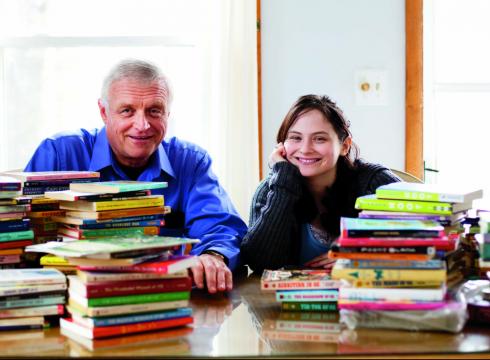
A Father's Promise
As Father’s Day approaces, I want to write about an
extraordinary father who made a promise to his daughter. The Reading
Promise: My Father and The Books We Shared, by Alice Ozma, is a magical,
and beautifully written, biographical tribute by Alice to her father.
When she was nine years old, Alice’s father, a school librarian, promised her that he would read aloud to her for the next one hundred nights. When that goal was reached, they celebrated with a pancake breakfast, and Alice proposed that they extend the project for another one thousand nights. Thus began an odyssey that continued for a further 3218 nights, finishing on the day Alice started university, at the age of eighteen!
It certainly wasn’t always easy, and Alice doesn’t shy away from discussing the
difficulties. What they termed, the "Reading Streak", was kept
up during some extremely tough times; during the heart-wrenching weeks after
Alice’s parents separate and her mother moves out, during the sad days
following her grandfather’s death. There are nights when her father reads over
the phone when she is away at sleepovers or school trips, and one memorable occasion in the school parking lot as Alice leans
sullenly against the car door. There is also a very touching description of a father reading
to a daughter, all decked out in her Prom gown finery.
The main thread of the book is the nightly ritual between father and
daughter, and the books that they share. They keep a meticulous list of these
which appears on the ”List of Books from the Reading Streak” at the back of the
book. As various books and characters are discussed, analyzed, some mentioned in
depth, others in mere passing, they are woven throughout the real life fabric of
Alice and her father’s lives. Gradually, Alice’s father’s deeply eccentric,
quirky, lovable nature is revealed. She paints a picture with amazing
precociousness and sensitivity, of not just the words they shared but also the
spaces in between.
During times of anger and awkwardness, embarrassment and teenage angst,
still he reads and she listens: sweetly sleepy, sad, joyous, anxious, silly, pensive, thoughtful
moods in turn. Father and daughter giggle and whisper, laugh and cry together.
Sometimes after a day spent in angry silence, the only spoken words between
them are the sound of his voice reading to her… “We read like
we always did. My father and I, together, sharing words that weren’t our own
but were still a part of our secret language.”
Alice's father's boundless belief in her created a young woman with rare self-possession and confidence. This is a mature book about a father/daughter relationship. It is about faith and trust, passion and
compassion, about a deep, abiding love and belief in each other. And in Alice's
own words, 'But more than that, it was a promise to the world; a promise to
remember the power of the printed word, to take time to cherish it, to protect
it all costs. He promised to explain to anyone and everyone he meets, the
life-changing ability literature can have.'
Thursday, June 12, 2014
Purple Lines
The Mag (The Promenade, 1918, by Marc Chagall )
PURPLE LINES
There are days when
all I want to be
is the sky surrounded by the sea.
There are days when
all I want to be
is a dancing wind above a tree.
There are days when
all I want to be
is a lavender song floating free.
There are days when
all I want to be
is a purple line of poetry.
Thursday, May 8, 2014
Smoke Screen
Smoke Screen
Fortune flashed in his hair,
in the dark of his eyes.
Summer skimmed the surface
of her thoughts.
She wondered what it would be like
to dance in his wind.
The stars drew his name
in clusters of burning points.
She wished on them.
She battled the air for knowledge.
She burned incense.
She dreamed of orange blossom
and spices on the altar of his being,
And she played the part of everyone
but herself.
Wednesday, April 30, 2014
Xanthe
(Xanthe, daughter of Oceanus, by Barbara Cooney.)
Last year I received a birth announcement from a friend's daughter announcing the arrival of her new baby girl; Xanthe Alexandria. The correct pronunciation of this is Zanthee, which I only discovered after a conversation with my friend.
In Greek mythology, Xanthe was a sea nymph, one of the Oceanids, the daughter of Oceanus and Tethys. In ancient Greek, Xanthe means 'golden one', which has also been interpreted as blonde-haired. More likely than not, little Xanthe will be the only child in her class with a name beginning with X. So too, by the time she starts school, she will probably be used to telling people how her name is pronounced.
The Romans had an expression nomen est omen, or "name is destiny." A name is part of a person's legacy. It will be recorded in history. You will say it thousands of times during the course of your life. It will be written on class lists, read out loud amongst throngs of others at graduation, spoken with portent on your wedding day, printed on business cards. Above all, rightly or wrongly, a name often conveys an image, an assumption about the person. It creates an impression.
Psychology professor, Albert Mehrabian, tested a host of names to see how people viewed them. Some names immediately aroused images of beauty or intelligence, others of popularity or kindness. Yet others were seen as artistic, nerdy or odd. On the whole, people judged to have more traditional names such as Rachel and Robert did extremely well. More alternative names scored badly. Breeze, for example, was viewed as being a poor student and business risk. Mehrabian feels that parents who choose or create bizarre names for their children are ignorant, arrogant or just plain foolish.
(from Google Images.)
Some celebrity offspring names are perfect illustrations of this case in point: Moxie Crimefighter, daughter of Penn Jillette and Emily Jillette, and Spec Wildhorse, son of John Cougar Mellencamp and Elaine Irwin, are but just two of a whole litany of bizarre names created by celebrities. The newest to add to the weird and wacky list are Kim Kardashian and Kanye West, whose newborn daughter faces the world with the moniker, North West. Poor wee soul ... it's all south from there.
Alaska's Sarah Palin, that Western avatar of traditional values, rather paradoxically named her children, Track, Bristol, Willow, Piper, and Trig. Perhaps there is a hidden part of her which yearns to be more artistic, less conservative, that is solely reflected in the names she chose for her children.
For many parents, picking out a baby name is like choosing the perfect nursery décor or baby accessories. It comes with a great deal of thought, reflection and personal taste. Some choose to name after beloved family members, sports legends, or heroic figures. (I named my oldest son, Nicholas, after my much loved maternal grandfather.) Others pick names which are trendy, popular, current. Some go the biblical route, or take a page from their favourite novel, movie or historical era. Yet others give nod to family tradition or their ethnic roots.
My four grandchildren have fairly unusual names. It is my personal policy to never get involved in any way in the naming of grandchildren. I had my turn. Now it is my children's right, and their joy to choose names. The agreement between my second son and the mother of their children was that he would choose the boys' names and she would pick the girls' names. They have two sons. My son picked both their names from the NHL (National Hockey League) roster. (Seriously!) Regardless of my own private personal opinion, my response to the announcement of each grandchild's name has always been the same, "That's lovely! I really like it. You've chosen something unique and strong/beautiful." And so it is, as I have grown to love each child's name as part of them.
I think that names perhaps have a greater significant influence when that is the only thing you know about a person. In time, people give personality and definition to their own names, good and bad. As Shakespeare said in Romeo and Juliet:
What's in a name? That which we call a rose,
By any other name would smell as sweet.
Xanthe's relative obscurity (not ranked in the top 1000 names), will take a bit of determination to make it work. She will stand out in a crowd of little girls named Emma (top girl's name in Canada for the last five years in a row), and among those bestowed with the tendency towards ever-more tortured, innovative spellings such as Mackenzie (McKynzee), Ava (Aayvah) and Taylor (Taelyr), all of which I have personally seen. In time, though, I have a feeling little Xanthe will come to define her name as a distinctive, interesting, spirited appellation.
(Small Possibilities, by Maggie Taylor.)
Subscribe to:
Posts (Atom)